Showing posts with label Carroll County. Show all posts

Sunday, July 17, 2011

The Last Deer

[Editor’s Note:  After hitting another deer on the road en route to work, I felt this story was a little relevant.]

As you travel the roads of upper Appalachia, whether they are the modern asphalt highways or the worn in dirt roads, it is hard not to see the constant presence of the whitetail deer. Signs dot the state routes warning of heavy deer crossing areas and a seemingly endless number of deer are seen throughout the area. It is almost unconceivable to think that for a century these silent beasts of the forest were nonexistent in the area.

When the French and British traders first began to explore the area of upper Appalachia they found many native wildlife species that soon became highly sought after trade goods. The pelts of beaver, fox, bear, panther, wolf, and deer became the driving force for western expansion and helped to put early America on the map as an invaluable source of commerce for the European markets. Moreover, the pelts were not all sent over the Atlantic, many were used bought and traded within the colonies, so much so that the deer pelt became interchangeable with forms of currency. The deer pelt was a very common and easily harvested fur to the point that the value of the skin was worth a dollar; therefore, since actual legal tender was in short supply on the frontier the hide of the deer was a common substitute as a form of currency. This is where the synonym of “a buck” came into being for the dollar.

The deer continued to be hunted and traded as western expansion crawled further and further west. As communities began to pop up along the ridges and valleys of the greater Ohio Valley the deer population began to decline as they were hunted as both a food source as well as a trade good.  By the 1830s a deer sighting became a rare event, as the forests were disappearing into cleared farmlands and the creatures were nearly hunted to the point of extinction.

In 1844, it became a historical fact that the last deer in Carroll County, Ohio was killed. James Ferrell a resident of Fox Township, in Carroll County and one of the original county commissioners was travelling the North Branch of Yellow Creek, when he spotted a deer. The deer was at a small salt lick and quickly spotted Ferrell. A chase then commenced and for three days a lengthy pursuit occurred crisscrossing the rough terrain of Northern Jefferson and Eastern Carroll counties. The chase ended by a well-placed rifle shot from Mr. Ferrell which dropped the weary beast, at which point a large feast was then held and the last of the native venison was savored by all of those in attendance.  

Deer in the area remained to be nonexistent for many decades to come.  Moreover, during the 1910s and 20s it was determined that deer no longer existed within the state of Ohio by the Ohio Division of Natural Resources.  This is further evidenced by a newspaper clipping from the Massillon Independent in 1926. In the article it describes how police were called to a Perry Township residence just west of Canton in Stark County, Ohio, to investigate “a horned beast, scaring the local citizens.” Upon further investigation that resulted in the death of the “beast” it was determined that the animal was in fact a buck that was believed to have travelled from deep in the mountains of Pennsylvania.

In years that followed the Stark County incident, deer slowly began to work their way back into the area. They began a slow steady growth in and around Ohio. By 1990, the deer population was estimated to be around 150,000 in the state of Ohio.  The current deer population is estimated to be close to 750,000 deer, where a reported 27,000 where killed on the roads by motorists and 261,000 deer were killed in Ohio by hunters with over 2000 killed in Carroll County.

It is hard to ever imagine a time without deer being a constant presence, and one can only imagine if you told James Ferrell that there would be so many deer roaming the area what his response would be.  However, although they create a lot of damage by way of vehicles and crop destruction they are still a mystical wonder of the woods that helped to establish this area in its pioneer days. Just as it hard to imagine what it would be like without deer around it is hard to imagine what this area would be like if we never had them.

Sunday, June 19, 2011

The Father of Carroll County

Editor’s Note: Since today is Father’s Day, I figured it was altogether proper and fitting that a history of Isaac Atkinson should be told as he is considered the “Father of Carroll County.”
There are so many things in life that you take for granted; never considering the how or whys of it. Such as the luxuries found in your own hometown.  For example, you do not really consider the matter of when you have to do county business, like paying those dreadful taxes, that you do not need to travel thirty miles away or the fact that the town is large enough that if you get a fast food craving or want to go grocery shopping you can just cruise into town in mere minutes. You never consider the fact that had it not truly been for one man; that this might just be another crossroads nestled among some rolling hills. This is the story of Isaac Atkinson, “The Father of Carroll County,” who took the small crossroads, backwoods town of Centreville and turned it into Carrollton, Ohio the county seat of Carroll County.

Isaac Atkinson
"Father of Carroll County"

Isaac Atkinson was born July 1, 1797 to Stephen and Mary (McMahon) Atkinson in Lancaster County, Pennsylvania.  Here he received his education in the classic one room school house, and soon obtained a solid sense of business by working in his father’s store. Around 1818, Isaac moved to Middleton in Columbiana County, Ohio and remained here for about four years before relocating to Centreville in southern Columbiana County.
When Isaac moved to Centreville, he came to a small town that less than seven years before had been carved out of the wooded rolling hills and platted by Peter Bohart.  Although the town had grown considerably since it was laid out on October 4, 1815, especially since it was located at the busy crossroads of the Steubenville-Canton and New Lisbon-Cadiz Pikes, its growth had plateaued as its all of its plots were close to being occupied. Isaac soon built a log store and home on the western edge of town (on present day South High Street between Main and 2nd Street SW), and grew quite successful. When Peter Bohart passed away in April of 1825, Isaac saw the opportunity to grow his wealth and the village in which he lived and purchased the Bohart Estate.

Sunday, June 12, 2011

The Story of the Park Hotel

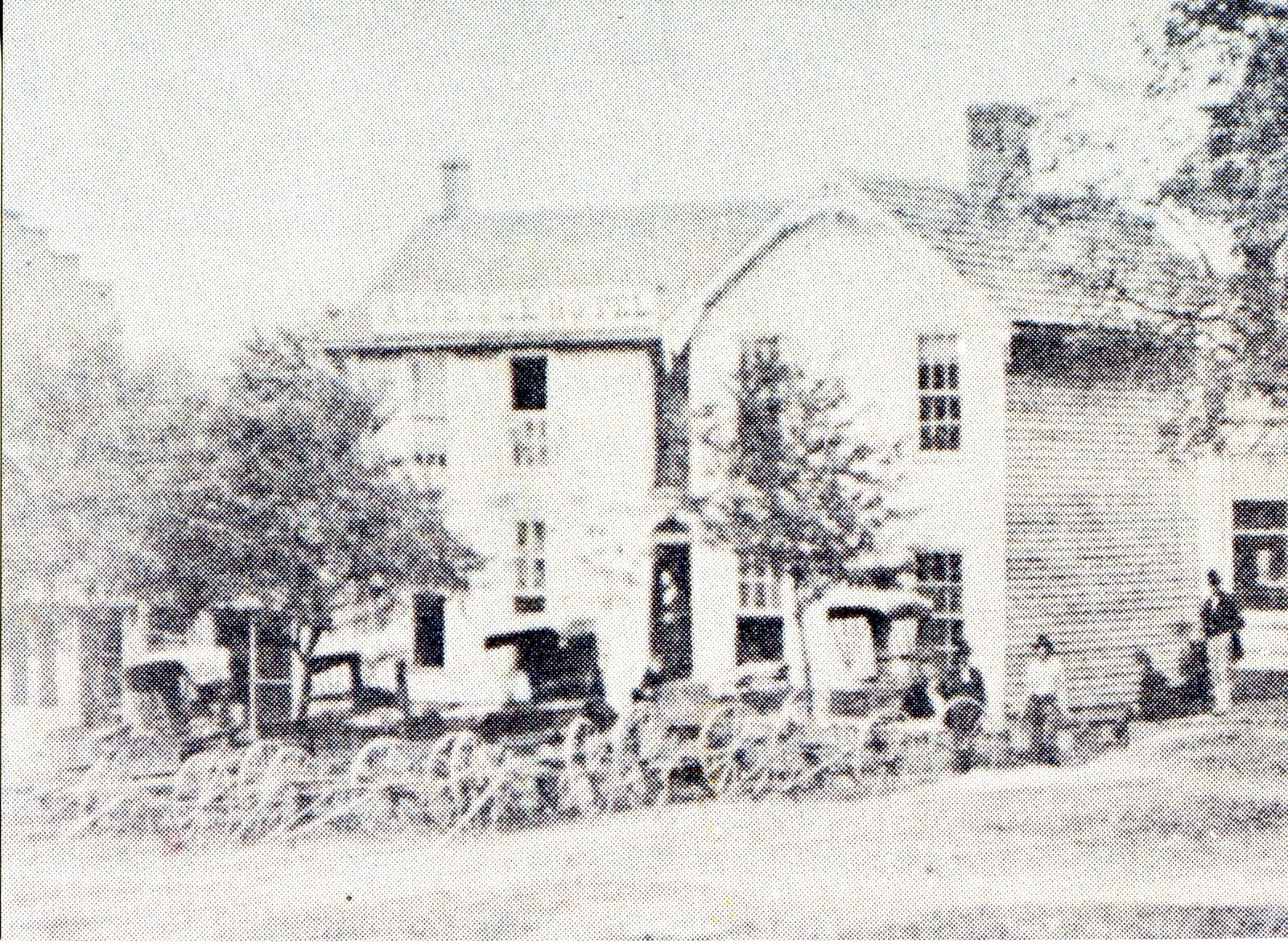
On the east side of the square in the small town of Carrollton, Ohio, stood a modest white clapboard building, which for 190 years sat in the shadow of the county courthouse . It was the resting place for many a weary traveler and also a social gathering place for many in the town. Built as a modest home, and later turned into a marble works, and finally a hotel, it was known as The Park Hotel.
In 1815, as Peter Bohart was laying out the village of Centreville in the backwoods of Ohio (present day Carrollton); the Roberts family built a large farmhouse for their growing family on Lot 32 of Bohart's Original Plat. The house was a simple “L” shaped house with a large front porch overlooking the square. Here the family grew larger and older and finally in 1859 sold the property.

The Aldridge Marble Works
From an Engraving, 1874

Nicholas J. Aldridge of New Cumberland, Ohio, came to Carrollton in 1850s, and opened a wood mill with his brother, Joshua. In 1857, at the age of 23, Nicholas purchased the Roberts home to house his new family and built a small store on the north end of the building. In this store he opened The Aldridge Marble Works, a trade that Nicholas learned as an apprentice from Armstrong Bathwell of Carrollton, along with mastering woodworking. The Aldridge Marble Works dominated this niche, producing nearly all of the cut marble and sandstone in the area, as well as, many of the tombstones. However, by 1877 Nicholas decided to retire from the masonry business and open up a hotel, much like his father operated in New Cumberland.
Nicholas made several additions to the back of the building and built an area above his old marble works for additional rooms and completely renovated the structure, and opened the hotel as The Aldridge Hotel. This was at the time Carrollton’s fourth hotel, following the Indian Queen Hotel, Hoopes House, and The Van Horn Hotel.

The Aldridge Hotel
circa 1880

In 1892, Nicholas Aldridge leased the hotel to Elias and Rebecca Fisher. Elias was the janitor at the new courthouse and so left the hotel business to his wife.  Rebecca first changed the name of the Aldridge Hotel to the Commercial Hotel. Mrs. Fisher then had the dining room area renovated and began to offer meals to both hotel guests and the general public. Her culinary skills soon became well known in the area and the dining portion of the hotel began to thrive.  However, around the turn of the century Mrs. Fisher’s health began to fail with her advancement in age and the doors of the Commercial Hotel were closed, and would remain so for a few years.
In December 1906, Mr. Grant Gregory made a deal with the Aldridge family and reopened the hotel. Mr. Gregory was a successful butcher that saw an opportunity in the hotel business after the Van Horn Hotel closed its doors earlier in the year. Mr. Gregory had purchased many of the furnishings from the luxurious Van Horn Hotel, and had them brought up the street to his newly renovated hotel. At this time, Mr. Gregory changed the name of the hotel once again and began to operate under the New Aldridge Hotel. However, Mr. Gregory apparently soon realized the hotel business was too much of a change from the butcher shop, and transferred his lease to John S. Shull. 

Sunday, June 5, 2011

The Fire And Brimstone Patriot

In the late eighteenth century there was a new wave of ideals sweeping the British colonies in America. The citizens of these lands thought of themselves more as free Americans than as subjects to the crown, and this idea was only compounded with each new generation born upon these soils. These new idealist felt that they should govern themselves with laws and taxes that they felt fit and that they should have the freedom to practice the religion of their choosing. One of these idealists was a young Pennsylvanian by the name of John Herrington.

John Herrington
His only picture on his 100th Birthday

On January 1, 1759, John Herrington was born in Pennsylvania to John and Martha (Berkley) Herrington. John was born into a developing area still hostile with wild game and frequent Indian Raids. In 1763, during the closing days of the French and Indian War, the Herrington family fled from an Indian attack; however, both of John parents died in this attack leaving the four year old boy orphaned. John was raised by a couple in the community that was devoutly faithful and taught the word of the Lord to the young lad.
When the Revolution broke out John soon enlisted with Captain John Redman’s company attached to the 11th Pennsylvania Regiment.  While in service John fought under General “Mad” Anthony Wayne in 1777 at the Battle of Brandywine, and again at the Battle of Paoli, where the regiment took heavy casualties.  Herrington spent the fateful winter of 1777-78 encamped at Valley Forge and saw his last engagement of the war at the Battle of Monmouth under Aaron Burr, before being mustered out of service.


Tuesday, May 17, 2011

The Case of Mistaken Identity and Murder: The Story of Jacob and Samuel Bushong

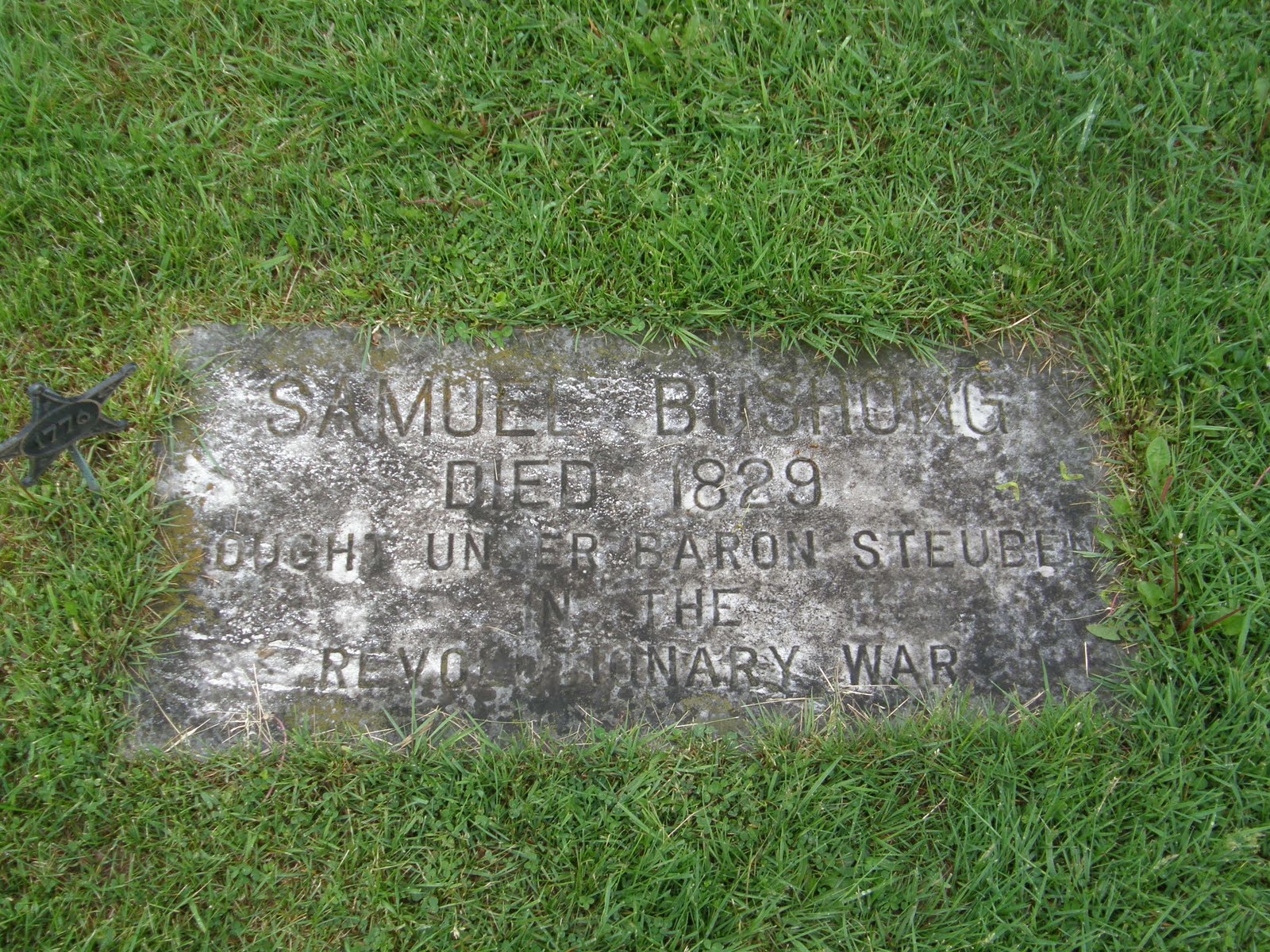
If you would visit Grand View Cemetery in Carrollton, Ohio, you will find the grave of the cemetery’s only Revolutionary War Veteran.  Underneath an impressive marble slab lies the body of a man who fought for this nation’s independence and blazed a trail into the frontier; building a solid foundation for his family and the newly formed village in which they lived. However, the name etched into the weathered marble headstone is not the name of the man buried beneath it.
Upon discovering the burial place for this Veteran of Independence, you will read will read carved into the tarnished marble: “Samuel Bushong Died 1829 Fought Under Baron Steuben in the Revolutionary War.” Not only is that the wrong name but also the wrong service record. The name of the true Revolutionary patriot is not Samuel Bushong, but his father Jacob Bushong.
In all of the early histories of Carrollton and Carroll County, the same oft-repeated mistake is made, and therefore, built upon and recognized as fact.  In the Carrollton Centennial published by the Free Press Standard it states, “Samuel Bushong – A native of Hesse Darmstadt, Germany; came to America with Baron Steuben and fought for the colonies in the Revolutionary War; he died here in 1835 and was buried in “the honors of war”; his unmarked grave is near that of Peter Bohart. He built the two story log house still standing east of Robert’s Park, in 1820.” This simple paragraph was repeated in many subsequent histories causing the truth to fall between the cracks. How and why this occurred is not clear, but it is finally time to right this wrong, and to do this all of the facts need to be looked at.  Since this is the story of two men it is only proper that both of their stories be told.

Sunday, May 15, 2011

The Man of the Tavern, Who Built a Town - Peter Bohart

Peter Bohart (1777-1825)
In 1809, a German immigrant, moved from Washington County, Pennsylvania to a small cross road in the new state of Ohio.  He soon built a two story log tavern at the cross roads of the Steubenville to Canton and New Lisbon to Cadiz pikes.  In the following years he slowly acquired land and on October 4, 1815 he platted the village of Centerville, Ohio.  His name was Peter Bohart. 
Bohart’s dream of a town started with the profitability of the whiskey and distillery business in the “West.” He recognized that as a result of the proximity of the village two basic needs had to be met. First, since the nearest market was thirty miles away, over rough terrain and sometimes impassable roads, marred with dangers, a market had to be established to sell the local goods and products of the area. The second need was a tavern and lodging for the weary travelers along the pikes.  Thus with his German grit and his sense of pioneering he went to work at meeting both needs for the area.